
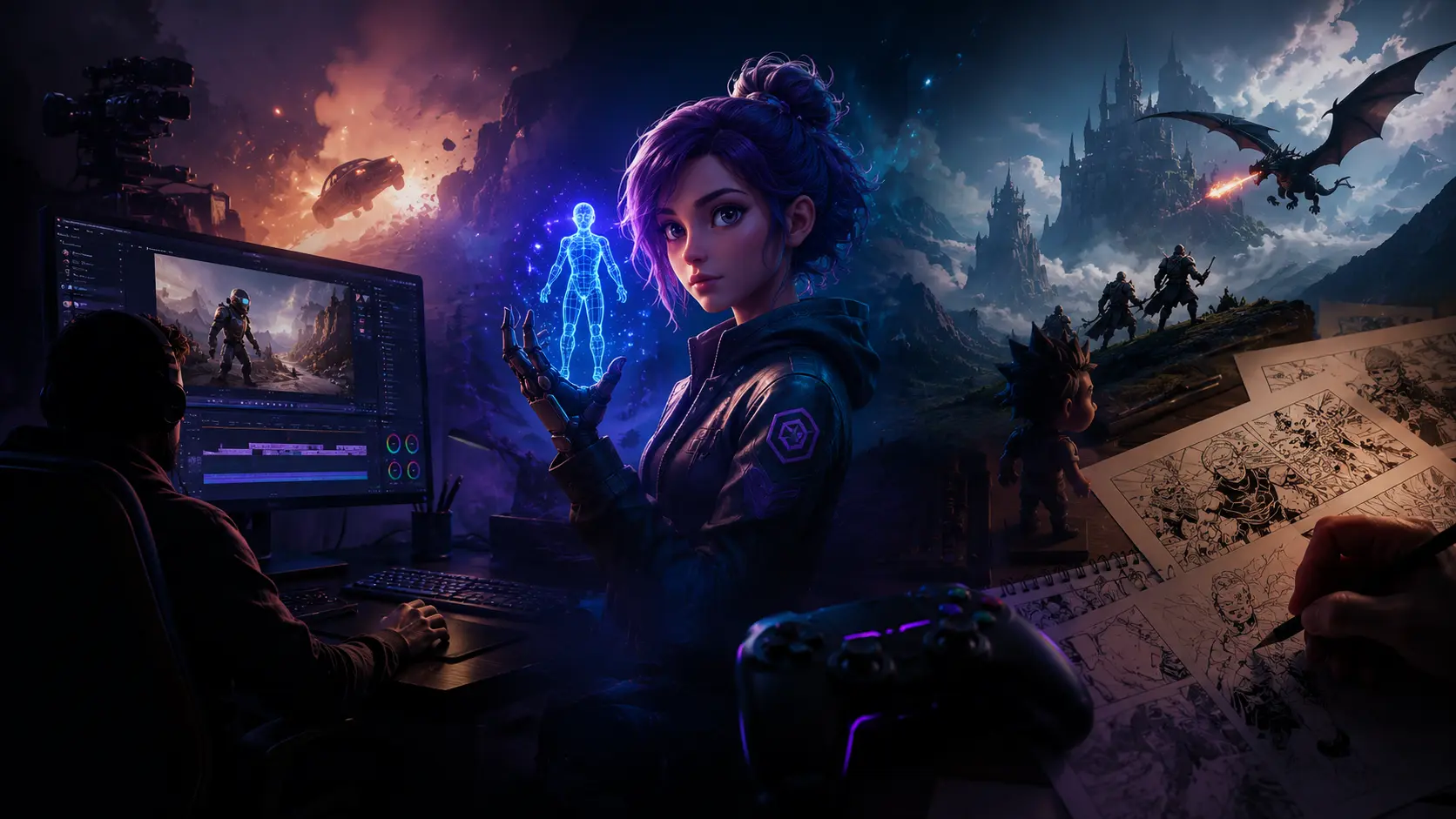
Course Overview
The Mastering AVGC (Animation, Visual Effects, Gaming & Comics) program is a comprehensive industry-oriented course designed to prepare students for successful careers in the rapidly expanding world of digital entertainment and interactive media. The AVGC industry has transformed the way stories are told, games are developed, films are produced, and digital experiences are created. From blockbuster Hollywood movies and AAA games to animated television series, advertising campaigns, augmented reality experiences, and digital comics, skilled AVGC professionals are shaping the future of entertainment across the globe.
This course combines creativity, technology, and practical production workflows to help learners develop professional skills that meet current industry standards. Students will gain hands-on experience with industry-leading software, understand complete production pipelines, and build an impressive portfolio through real-world projects. Whether you are an aspiring animator, game designer, VFX artist, illustrator, or digital storyteller, this program provides the knowledge and practical expertise required to excel in today's competitive creative industry.
Unlike traditional classroom learning, this course emphasizes practical implementation over theory. Every module includes project-based learning, creative assignments, portfolio development, and industry case studies that simulate real production environments. Students will work on multiple individual and collaborative projects while learning professional workflows followed by animation studios, gaming companies, production houses, and creative agencies worldwide.
Why Choose This Course?
The AVGC sector continues to experience remarkable growth due to increasing demand for digital entertainment, online gaming, OTT platforms, virtual production, immersive experiences, and interactive content. Organizations are constantly searching for skilled professionals capable of producing high-quality creative content using modern technologies.
Our curriculum has been carefully designed by industry professionals and academic experts to bridge the gap between classroom education and professional studio requirements. Students not only learn software but also understand design thinking, storytelling, production management, teamwork, problem-solving, creativity, and professional communication skills required in today's workplace.
- Industry-focused curriculum updated with current trends and technologies.
- Hands-on practical training using professional production workflows.
- Real-world assignments and studio-based project development.
- Comprehensive portfolio development throughout the course.
- Experienced mentors with industry knowledge.
- Career guidance, resume building, and interview preparation.
- Exposure to animation, VFX, gaming, comics, and digital storytelling.
- Practical knowledge suitable for freelancing, entrepreneurship, and employment.
Course Objectives
The primary objective of this course is to develop highly skilled creative professionals capable of producing professional-quality digital content across multiple creative domains. Students will learn to combine artistic creativity with technical expertise while understanding complete production pipelines used in the entertainment industry.
Upon successful completion of this course, learners will have developed strong conceptual thinking, digital production skills, visual communication abilities, storytelling techniques, software proficiency, and collaborative project management skills necessary to contribute effectively within professional production environments.
Detailed Curriculum
Module 1 – Fundamentals of Design & Digital Creativity
Students begin their journey by understanding the fundamental principles of visual design. This module introduces composition, color theory, typography, perspective drawing, lighting, visual hierarchy, storytelling fundamentals, digital sketching, and creative thinking techniques that form the foundation of every successful creative professional.
Module 2 – Digital Illustration & Character Design
This module focuses on creating compelling characters with unique personalities. Students explore anatomy, facial expressions, gesture drawing, costume design, silhouettes, environment concepts, creature creation, prop design, and professional illustration workflows using digital drawing software.
Module 3 – 2D & 3D Animation
Animation principles such as squash and stretch, anticipation, timing, spacing, follow-through, overlapping action, staging, exaggeration, arcs, secondary motion, and appeal are covered extensively. Students learn storyboarding, animatics, character rigging, keyframe animation, camera movement, rendering techniques, and production planning.
Module 4 – Visual Effects & Motion Graphics
Students learn modern visual effects workflows including compositing, chroma keying, masking, rotoscoping, particle systems, motion tracking, color grading, cinematic transitions, green screen production, visual simulations, and advanced motion graphics suitable for films, advertisements, and digital media.
Module 5 – Game Design & Interactive Media
This module introduces game production concepts including gameplay mechanics, level design, environment creation, UI/UX for games, asset optimization, physics systems, game engines, scripting fundamentals, character controllers, and interactive storytelling. Students create playable experiences while understanding professional game development pipelines.
Module 6 – Comics & Visual Storytelling
Students learn comic illustration, page composition, storyboard creation, sequential storytelling, dialogue placement, panel layouts, pacing, inking, digital coloring, publishing workflows, and graphic novel production techniques. Emphasis is placed on effective storytelling through visuals.
Module 7 – Portfolio Development
A professional portfolio is one of the most important requirements for entering the creative industry. Students will develop multiple polished projects including animations, concept art, VFX sequences, game environments, character designs, and comics that demonstrate their abilities to potential employers and clients.
Software & Tools Covered
| Category | Software & Technologies |
|---|---|
| Digital Design | Adobe Photoshop, Adobe Illustrator |
| Animation | Blender, Autodesk Maya |
| Visual Effects | Adobe After Effects, Nuke |
| Video Editing | Adobe Premiere Pro, DaVinci Resolve |
| Game Development | Unity Engine, Unreal Engine |
| Digital Sculpting | ZBrush (Introduction) |
Projects You'll Build
Throughout the course, students will work on multiple portfolio-quality projects that simulate professional production environments. These projects are carefully designed to strengthen technical expertise, creativity, teamwork, and production management skills.
- Professional Character Design Project
- Short 2D Animation Film
- 3D Animated Scene
- Visual Effects Composition
- Motion Graphics Advertisement
- Fantasy Environment Design
- Interactive Game Level
- Comic Book Sample Chapter
- Professional Showreel
- Complete Digital Portfolio
Career Opportunities
The skills acquired during this program prepare students for a wide range of exciting career opportunities across animation studios, gaming companies, film production houses, advertising agencies, OTT platforms, digital marketing firms, educational technology companies, architecture visualization studios, and independent creative businesses.
| Career Role | Description |
|---|---|
| Animator | Create character animations for films, games, television, advertisements, and digital media. |
| VFX Artist | Produce cinematic visual effects, compositing, simulations, and post-production work. |
| Game Artist | Design game environments, characters, props, textures, and interactive assets. |
| Concept Artist | Create visual concepts for films, games, animation, and product visualization. |
| Motion Graphics Designer | Develop animated graphics for advertising, branding, television, and online media. |
| Comic Illustrator | Create graphic novels, comics, storyboards, and sequential artwork. |
| Storyboard Artist | Plan visual sequences for films, animation, advertisements, and games. |
| 3D Generalist | Handle modeling, texturing, lighting, rendering, and animation workflows. |
Who Should Enroll?
This program is suitable for school graduates, college students, aspiring designers, artists, content creators, photographers, video editors, illustrators, game enthusiasts, working professionals looking for career transitions, freelancers, entrepreneurs, and anyone passionate about creativity and digital entertainment.
No prior experience is required. The course begins with fundamental concepts and gradually progresses toward advanced production techniques, allowing beginners as well as intermediate learners to benefit equally from the curriculum.
Learning Outcomes
By the end of this program, students will possess a comprehensive understanding of animation, visual effects, game design, digital illustration, and comic production. They will be capable of independently planning, designing, producing, and presenting professional-quality creative work while confidently using industry-standard software and production methodologies.
Graduates will also develop a professional portfolio demonstrating their technical abilities, creative thinking, storytelling skills, and production experience, significantly enhancing their employability within the global AVGC industry.