
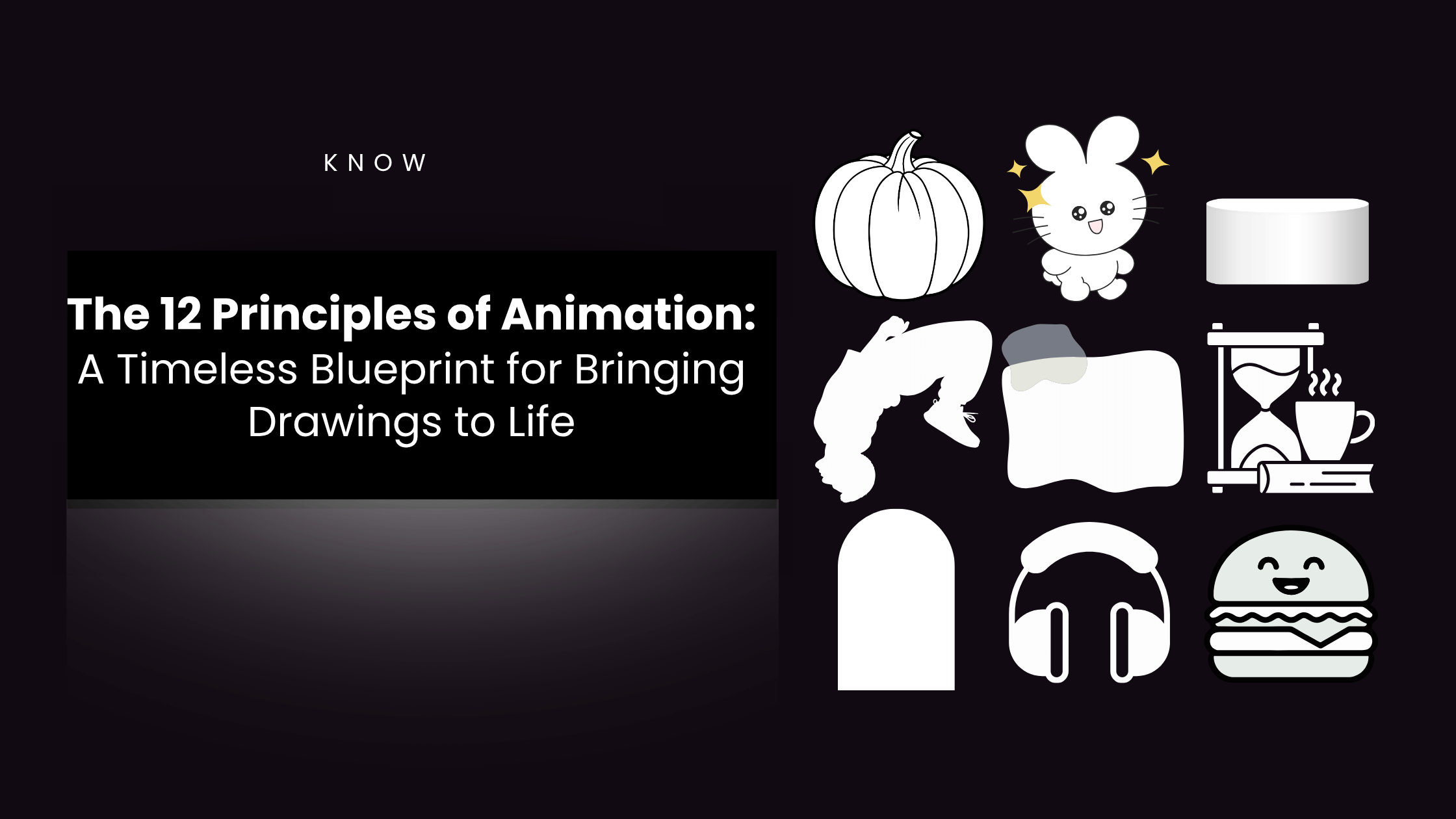
The 12 Principles of Animation: A Timeless Blueprint for Bringing Drawings to Life
In 1981, two veteran Disney animators, Ollie Johnston and Frank Thomas, published The Illusion of Life: Disney Animation. In it, they codified a set of techniques that Disney's animators had been refining since the 1930s — techniques that took flat drawings and gave them weight, personality, and believability. These became known as the 12 Principles of Animation, and nearly a century later, they remain the foundation of animation education, whether you're working in hand-drawn 2D, 3D CGI, stop-motion, or motion graphics.
Here's a walk-through of all twelve, what they mean, and why they still matter.
1. Squash and Stretch
This is widely considered the most important principle. Squash and stretch gives an object a sense of weight, flexibility, and life by deforming its shape during movement — think of a bouncing ball flattening as it hits the ground, then stretching as it springs back up. The key rule: no matter how much a shape squashes or stretches, its volume should stay consistent. A ball that stretches shouldn't also get bigger. This principle applies to everything from a simple ball to a character's face during an exaggerated expression.
2. Anticipation
Real movement rarely happens instantly. Before a character throws a punch, they wind up. Before jumping, they crouch. Anticipation prepares the audience for a major action, making it more readable and impactful. Without it, movement feels abrupt and mechanical — a character who jumps without any crouch first will look like they're teleporting rather than jumping.
3. Staging
Staging is about clarity of intent. Every idea in a scene — an action, a mood, an expression — should be presented so that it's unmistakable to the audience. This involves camera angle, character placement, lighting, and timing, all working together to draw the eye exactly where it needs to go. A well-staged shot never leaves the viewer wondering what they're supposed to be looking at.
4. Straight Ahead Action and Pose to Pose
These are two different approaches to actually creating the animation.
- Straight ahead action means drawing frame by frame in sequential order, from start to finish. It tends to produce more spontaneous, fluid results — great for fire, water, or wild chase sequences.
- Pose to pose means drawing key poses first, then filling in the frames between them. It gives the animator more control over composition and timing, and is easier to plan for dramatic or emotional scenes.
Most professional animation blends both methods depending on the shot.
5. Follow Through and Overlapping Action
Nothing in the real world stops all at once. When a character comes to a halt, their hair, clothing, or a held object will keep moving briefly before settling — this is follow through. Overlapping action is the related idea that different parts of a body don't move in perfect unison; an arm might lag slightly behind the torso during a turn. Together, these principles prevent movement from feeling stiff and robotic.
6. Slow In and Slow Out
Also called "ease in, ease out," this principle addresses the spacing of frames near the beginning and end of a movement. Objects in the real world accelerate and decelerate — they don't move at a constant speed and then stop dead. By clustering more frames near the start and end of an action and fewer in the middle, animators mimic this natural acceleration and deceleration, making motion feel smooth and organic.
7. Arc
Most natural movement — a swinging arm, a nodding head, a thrown ball — follows a curved trajectory rather than a straight line. Animating along an arc rather than a rigid path makes motion feel more lifelike, since biological movement is governed by joints rotating around pivot points, not moving in mechanical straight lines.
8. Secondary Action
Secondary actions are gestures that support and add richness to a primary action, without pulling focus from it. A character walking (primary action) might swing their arms, whistle, or glance around (secondary actions). Done well, secondary action adds dimension and personality; done poorly, it distracts from the main event — so it always has to stay subordinate to the primary movement.
9. Timing
Timing refers to the number of frames used for a given action, which determines its speed. This has enormous expressive power: the same action animated over a few frames feels frantic or urgent, while stretched over many frames it feels slow, weighty, or deliberate. Timing also carries emotional and physical meaning — a heavy character moves differently than a light one, and a nervous character moves differently than a confident one, purely through timing choices.
10. Exaggeration
Animation that copies reality too literally often feels flat and lifeless on screen. Exaggeration pushes poses, expressions, and actions slightly (or dramatically) beyond realism to make them read more clearly and with more energy. This doesn't mean distorting things randomly — good exaggeration stays true to the essence of the action or emotion while amplifying it for effect.
11. Solid Drawing
Solid drawing means understanding basic principles of form, weight, volume, and anatomy well enough to draw a character convincingly in three-dimensional space, from any angle. Even in a stylized or cartoonish world, characters need to feel like they occupy real, consistent volume — avoiding what animators call "twins" (symmetrical, lifeless poses) in favor of dynamic, balanced forms.
12. Appeal
Appeal is about charisma—making a character interesting and compelling to watch, whether they're a hero, a villain, or a background character. This isn't about making everyone "cute" or likable in a conventional sense; a menacing villain can have appeal through a strong, well-designed silhouette and expressive design. Appeal is what makes an audience want to keep watching a character.
Why These Principles Still Matter
It's worth remembering that these principles were developed for hand-drawn animation on paper, decades before computers were part of the process. Yet they've proven remarkably durable—every major 3D animation studio, from Pixar to DreamWorks, still teaches them as foundational knowledge, and they show up constantly in game design, motion graphics, and UI/UX animation as well. Even a simple loading spinner or a button press animation on a phone often leans on ease in/ease out or squash and stretch to feel satisfying rather than robotic.
That's really the throughline connecting all twelve principles: they're not arbitrary rules, but observations about how movement, weight, and personality actually read to a human eye. Master them, and you're not just animating — you're creating the illusion of life.